Showing posts with label military. Show all posts

Monday, November 13, 2006

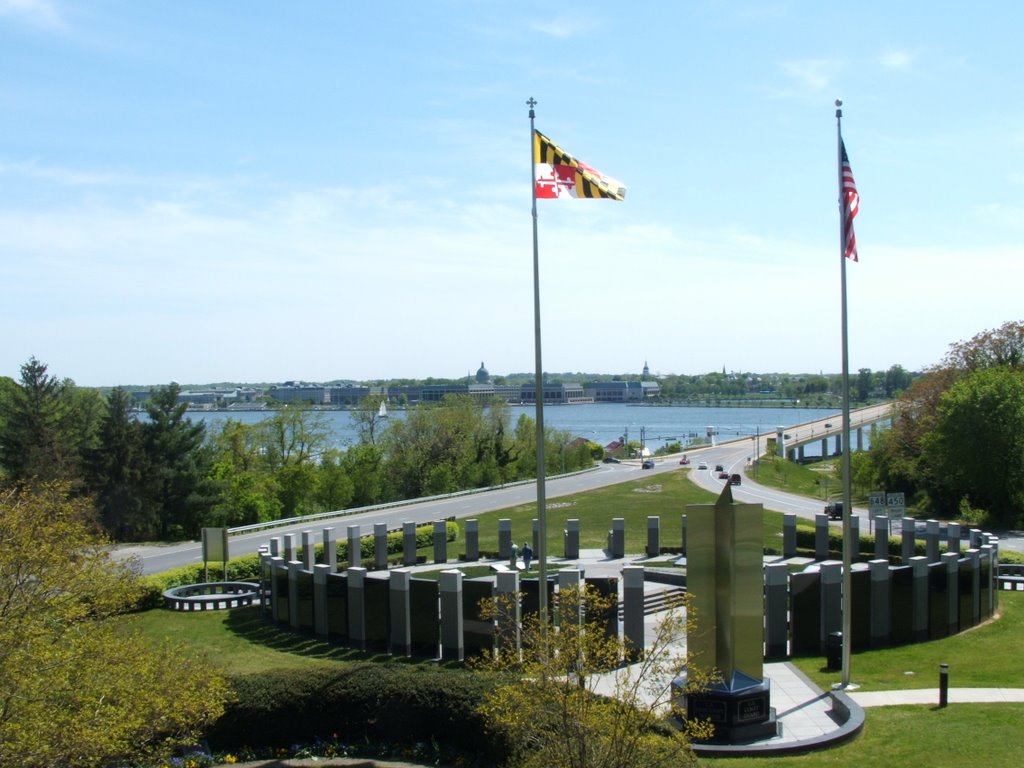
Paddle Bell Memorial to Submariners

I found this memorial to submariners lost at sea on the U.S. Naval Academy campus. See also a previous post of mine, "Courage Runs Deep."


Picture taken in May 2006 in Annapolis, Maryland

Monday, October 30, 2006

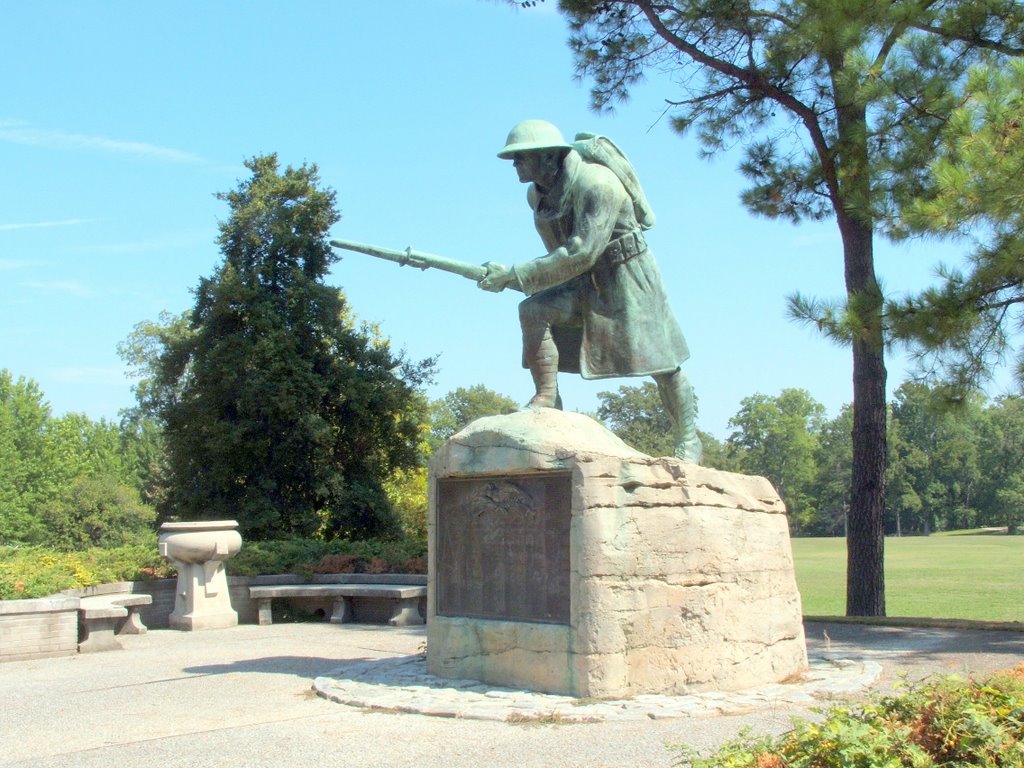
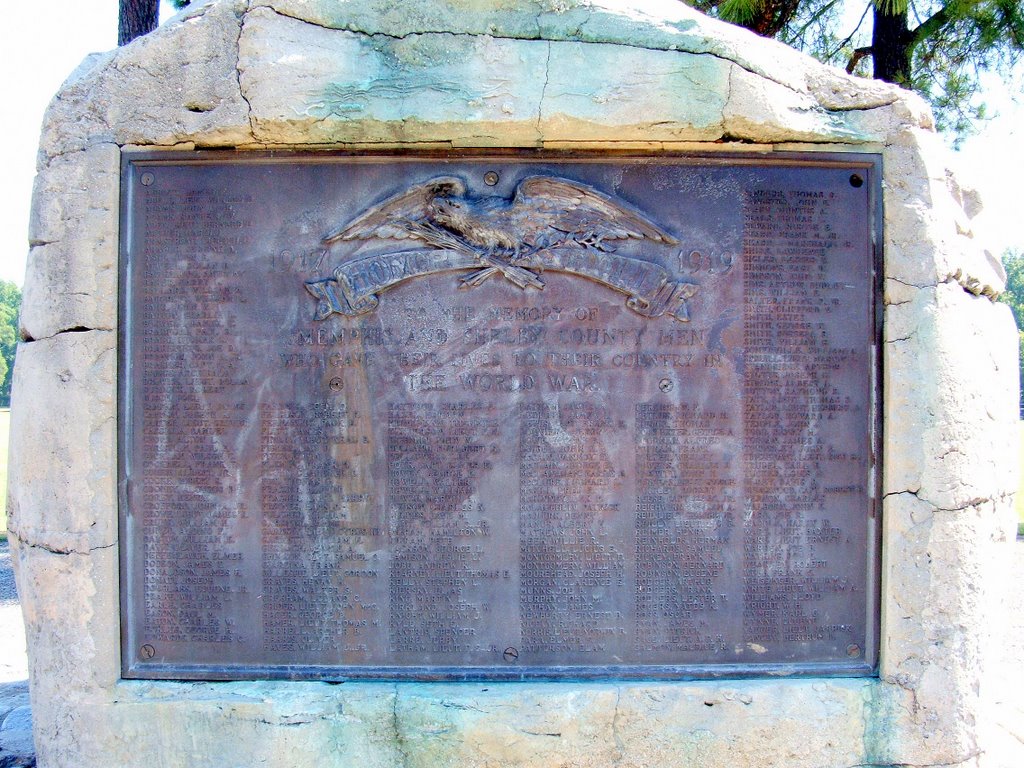
Memphis World War I Memorial

I found this memorial to Memphis, Tennessee and Shelby County soldiers who lost their lives in World War I just outside the entrance to the Memphis Zoo in Overton Park.


Sunday, June 18, 2006

Images from the USS Texas

I took the following pictures onboard the USS Texas in the summer of 1985 somewhere northwest of Pearl Harbor, Hawaii. The USS Texas is a Virginia class guided missle cruiser.


The sea for this Pacific ocean sunset was glassy smooth, smoother than I thought possible on the ocean.


Sunday, May 14, 2006

The Other WWII Memorial

On a recent visit to Annapolis, Maryland I stumbled across the Maryland World War II Memorial. I posted pictures of the National WWII Memorial a while back. The memorial is located immediately across the Severn River from the U.S. Naval Academy.


The memorial has the names of Maryland residents killed in the armed forces during WWII.

Saturday, May 06, 2006

Remember the Maine!

The USS Maine was blown up in Havana harbor on February 15, 1898. The foremast of the USS Maine was recovered on October 6, 1910 and errected as a memorial on the campus of the US Naval Academy in Annapolis, Maryland on May 5, 1913.


US Naval Academy campus

United States Naval Academy in Annapolis, Maryland on the banks of the Severn River. Picture taken from the opposite side the river in April 2006. The large dome to the right of center is the US Naval Academy Chapel. The second and smaller appearing dome-like structure a little farther to the right is the top of the Maryland State Capital building just a couple of blocks up Marland Avenue on the back side of the campus.

 Posted by Picasa

Wednesday, May 03, 2006

Courage Runs Deep - Submariner Memorial

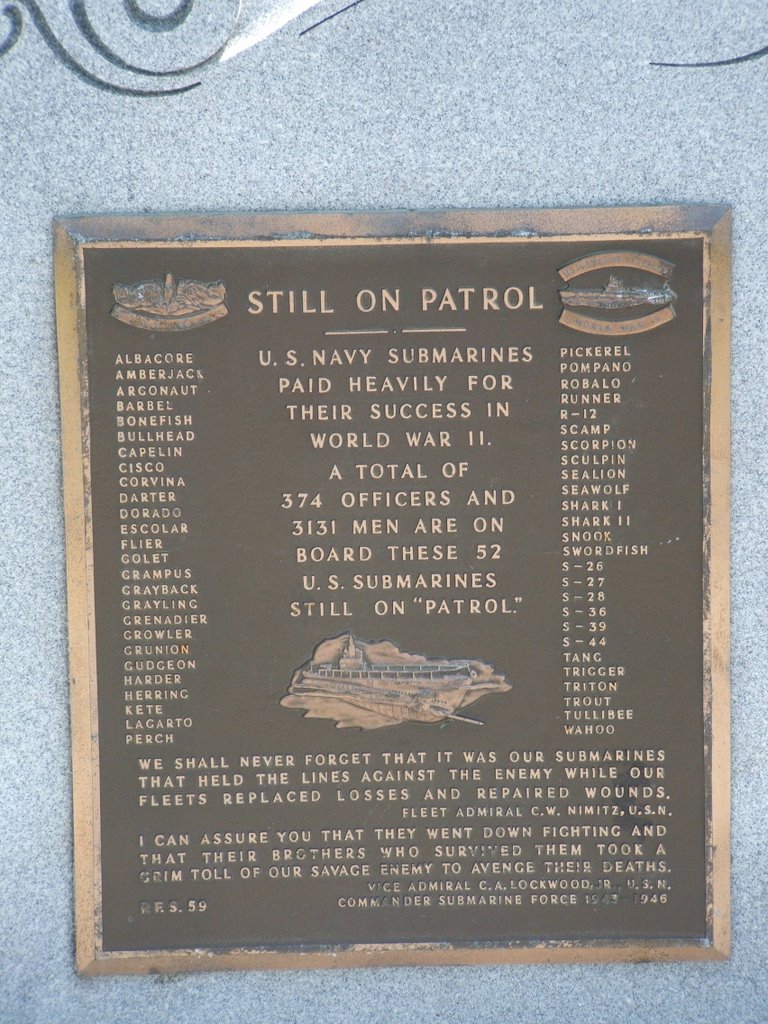
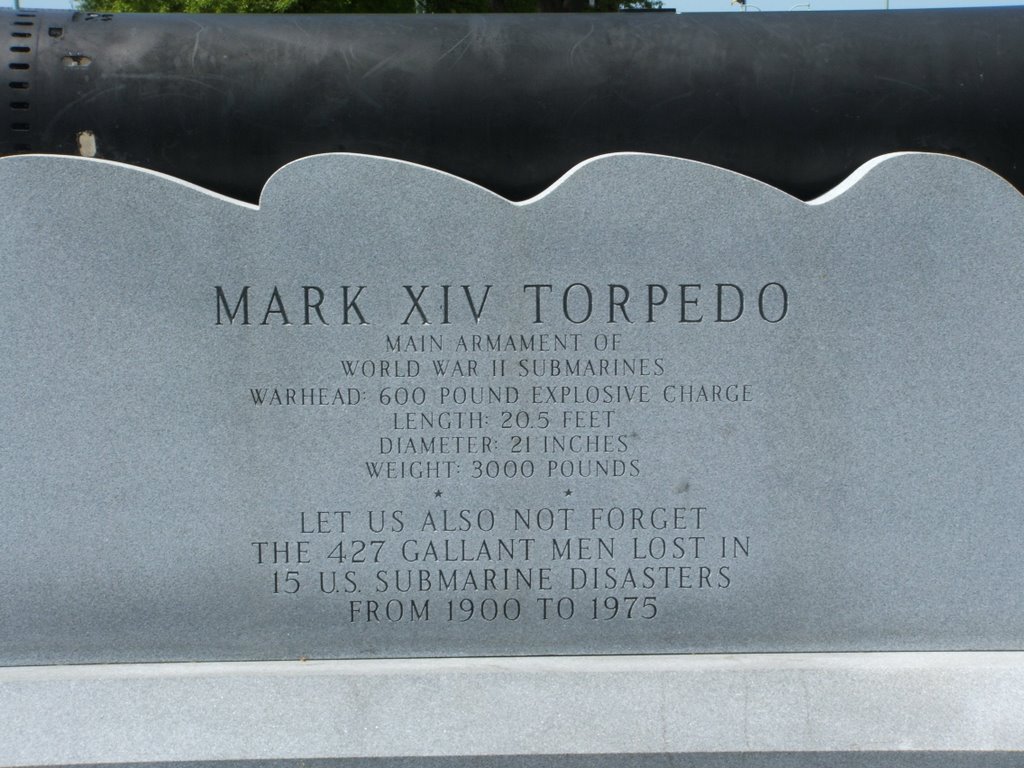
Below are some pictures of a memorial to the 3000+ WWII submariners who lost their lives in the line of duty on 52 submarines "still on patrol". I took the pictures in April 2006 on the campus of the US Naval Academy in Annapolis, Maryland. The view behind the memorial is out into the mouth of the Severn River where it joins the Chesapeake Bay at Annapolis.


close up of the brass plaque....

the back side...

Monday, May 01, 2006

US Naval Academy Campus

A squadron of sailboats used by the Midshipmen at the US Naval Academy to race against each other and learn seamanship. Picture taken from the US Naval Academy campus along the Severn River in Annapolis, Maryland in April 2006.

The sailboats have names like Challenger and Resolute.

Posted by Picasa

Politically Incorrect Tax Dollars at Work: US Naval Academy Chapel #1

The entrance to the United States Naval Academy Chapel in Annapolis, Maryland. Picture taken in April 2006.


 Posted by Picasa

Sunday, April 30, 2006

Washington, DC Surrounded by the Confederacy?

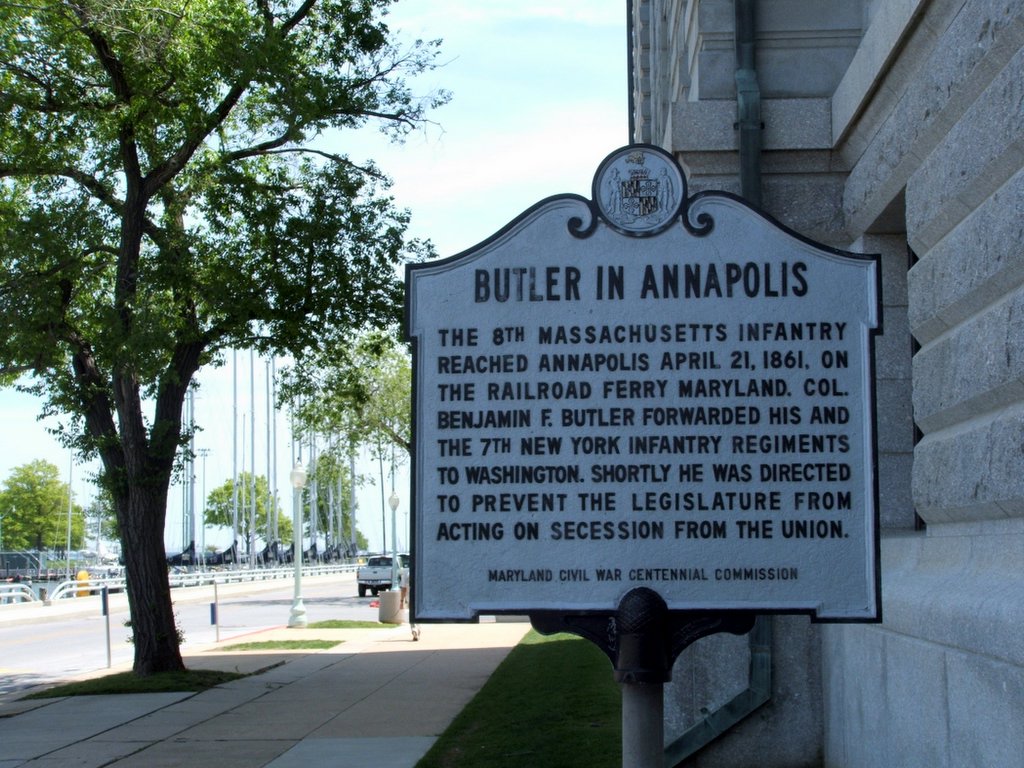
I find the historical marker below on the campus of the United States Naval Academy in Annapolis, Maryland really interesting. It isn't necessarily well known that owning slaves was legal in Maryland when the Civil War broke out in the United States. However, Maryland and a few other "slave states" did not secede from the United States of America (the Union) to join the Confederate States of America. (Missouri was another example of a slave state which did not secede.)

If you don't know your geography very well, you may not realize that Maryland is immediately west, north, and east of Washington, DC. Virginia which was part of the Confederacy was to the west, south, and east. Therefore, if Maryland had sided with the Confederacy in the Civil War, President Abraham Lincoln and the United States Capital in Washington, DC would have been surrounded by the Confederacy.

Based on the historical marker below, it appears that the Union did not want to allow this unpleasant possibility to occur. Union troops took over the Maryland capital of Annapolis and physically prevented the Maryland Sate Legislature from convening and even considering a motion to secede from the Union.

I'm not advocating this should have happened... I'm glad we no longer allow slavery. However, just imagine how United States history might have been different if Washington, DC had been surrounded by the Confederacy at the beginning of the Civil War.

 Posted by Picasa

Tuesday, March 07, 2006

Senator John McCain - Faith of My Fathers

As I’ve mentioned before I am an avid “reader” of audio books. My most recent book was Faith of my Fathers by US Senator John McCain and Mark Salter. I must say I learned a great deal about the men that shaped the life of one of my favorite politicians.

Senator McCain’s Grandfather
  • Annapolis graduate
  • A US Navy officer who rose to at least 3-star Admiral but I think he made it to, reporting directly to Admiral Halsy. He might have been a 4-star.
  • Involved in numerous naval battles in WWII as commander of squandron of fast carriers.
  • Was present at the Japanese surrender ceromony in Tokyo Bay.
  • Had one major incident of adversity. He was relieved of his command near the end of WWII not for failure with the enemy but for damage to ships and for men washed overboard and lost at sea during a typhoon.
  • Died just a few days after returning home after WWII.
Senator McCain’s Father
  • Annapolis graduate, graduating in the bottom 25%
  • Commanded submarines during WWII
  • Eventually rose to 4-star admiral.
  • Was appointed to the US Navy’s second highest position, Commander in Chief Pacific (CINCPAC) during the Vietnam War.
  • Henry Kissinger told future Senator McCain after the war that whenever he felt President Nixon was losing his resolve to fight the North Vietmanese, he would arrange for Senator McCain’s father to brief President Nixon on the war and miliary options.
  • Died like his father, shortly after fighting his nation’s war.
Senator McCain
  • Annapolis graduate, graduating near the bottom.
  • Naval aviator.
  • Volunteered for combat assignment off Vietnam.
  • Asked to be part of a particularly dangerous mission over Hanoi.
  • Shot down over Hanoi.
  • Injured in the shootdown, denied medical treatement for a long time until the Vietmanese realized his father was CINCPAC.
  • Could not move his arms or walk for months.
  • Beaten and tortured in prison.
  • Was once beaten so severly he signed a war crime “confession” and made an audio recording which was played over the loud speaker at the prison camp, humiliating him.
  • Offered early release from POW camp in Vietmanese attempt to embarase his father was a “big admiral” but he refused to leave before others who had been imprisoned longer.
  • When released from POW camp, he could barely walk without crutches due to untreated injuries. After some surgery and physical therapy, he eventually got flight status back but was eventually dischardged.
Other interesting stories include:
  • At the beginning of the war, the US was so afraid of China or the Soviet Union joining the conflict that Washington refused Navy recommendations to mine North Vietnamese harbors for fear of damaging Chinese and Soviet ships.
  • McCain flew over Soviet ships with surface to air missles being offloaded from the deck, but was under orders not to bomb the Soviet ships.
  • The US also resisted the idea of bombing Hanoi
  • How POW’s would communicate with each other via tapping on walls and talking thru drinking cups.
  • Stories of deep friendships formed between isolated men who might not see each other much, simply from being willing to risk the beatings to communicate with them.
  • How POW’s would celebrate date such as birthdays and anniversary of joining their military service as a group whenever possible.
  • How the POW’s once waged a hunger strike to get the privilege of weekly religious services.
  • How the POW morale improved greatly when they heard B-52 raids over Hanoi. They took this as a sign that the US was finally showing the resolve to fight hard enough to bring the war to a close and get them home. They cheered as their guards saught shelter from the raids. One one occasion, shrapnel sprayed his POW camp but they clapped and cheered anyway.
  • How two US officers in one of the POW camps capitulated to the enemy and helped the North Vietmanese identify prisoners who were communicating with each other, one time turning in McCain. McCain received a beating as a result.
  • Once McCain was bound tightly, beaten, and left tied up tighly for the night. A camp guard he had not had much interaction with came in and quietly loosened the ropes that bound him that evening. The same guard returned early in the morning and tightened the ropes again. A couple of days later, the guard came along side him and without speaking made a Christian cross in the dirt with his foot. Niether spoke. The man then erased the cross with his foot and walked away, never speaking to McCain.

I highly recommend this book as a story about adversity and how much adversity people can withstand. Its also worth it as a reminder about the sacrifice that some members of our Armed Forces have willingly made for our freedom.


Monday, February 20, 2006

Shadow Warriors

I’ve finished reading another book. (Well, actually I finished listening to an audio book.) I’ve always been a Tom Clancy fan and I just finished Shadow Warriors: Inside the Special Forces by Tom Clancy with General Carl Stiner (retired) and Tony Koltz.

The book is basically a collection of stories, experiences, and anecdotes about those members of the United States armed forces who belong to special forces units such as the Green Berets, the US Navy SEALs, the pilots who fly their special mission planes and helicopters, etc. From this I learned more than I expected to learn about world history since the World War II years.

The precursors to today’s special forces who parachuted in behind enemy lines into German-occupied France to work with French Resistance fighters had to walk quite a political tightrope between the monarchists, the Gaulists, and the communists. The communists were the most troublesome. Near the end of the war, one group of communist aligned resistance fighters stopped cooperating, captured a munitions factory, and began making weapons to be used in an armed revolution they wanted to start as soon as the Germans were expelled from France.

President John F. Kennedy was a big supporter of the concept of “special forces” because he anticipated low intensity conflicts and guerilla led fighting.

The entrace requirements to the Army Special Forces were raised sometime during or shortly after Vietnam to include a minimum IQ of 120. Language, cultural, and political skills became extremely important. “Rambo” types were not really what they wanted. They wanted men who could work to gain cooperation of native guerilla and tribal forces.

General Stiner was assigned as a liason with the armed forces of Lebanon prior to the bombing of the Marines barracs that killed 220 US Marines in 1983. He describes in great detail the friction, animosity, political agendas of the the Christians supported by Israel, the Druze supported by Syria, and Hezbollah supported by Iran. I also learned how the Lebanese constitution set up by the French used the resuls of an out-of-date census in 1930 to distribute political offices by religion. For example, the top leader of Lebanon was designated to be a Christian because the Christians were the largest ethnic group in 1930. By 1983, Muslims outnumbered Christians but the allocation of political offices had not changed. No wonder the Middle East is such as mess!

General Stiner led a response team to the TWA Flight 847 hijacking in 1985. He described how delays in getting lift aircraft affected their ability to try to mount a rescue while the plane was on the ground in Beruit. When the plane flew to Algiers, the government there would not allow a rescue attempt. When the plane returned to Beruit, the terrorists were reinforced with heavily armed men and some 40 of the passengers were removed from the plane and taken to different locations making rescue difficult if not impossible. This experience led to the assignment of dedicated lift aircraft to support special forces activities.

General Stiner was also involved in US actions to capture the terrorists who hijacked the Achille Lauro in 1985 and killed a wheelchair-bound Jewish-American passenger. The terrorists were forced to land in Sicily where there was quite a political standoff about whether Italy or the US would get to prosecute the terrorists. Italy got to prosecute the terrorists but they let the hijacking mastermind Abu Abbas escape via a plane to Yugoslavia because of supposed diplomatic immunity.

A huge amount of effort went into the American invasion of Panama to capture the corrupt President Noriega in 1989 and support the lawfully elected government. A few interesting facts (or trivia depending on your point of view).
  • Because of their bombing accuracy, the F-117 Stealth Fighter was used to drop 2000 pound bombs on a very precise location so as to create a diversion without harming civilians as US paratroopers were landing to take over a shared US-Panamanian army base. The shared base had housing for the family members of both Panamian and US troops. This may have been the first use of the Stealth aircraft in combat. The aircraft were still a “black” secret prior to the first Gulf War with Iraq.
  • To gain refuge in the Vatican Embassy, Noriega apparently told an embassy official that if he was not allowed sanctuary, he would go into the mountains to lead a guerilla war.
  • Evidence was found in Noriega’s homes that he practiced witchcraft. Understandably, this did not sit well with representatives of the Catholic Church while he was hiding in their embassy.

A small group of four US soldiers were inserted well behind Iraqui lines during the first Gulf War to observe troop movements along a major highway. They were initially sent out by helicopter, recalled, and then sent out again. They used so much fuel they had to return to base to refuel before going out the second time. As a a result they did not have enough time before daylight to dig a good hole to hide in. Their less secure hiding place in a ditch was discovered soon by a couple of little girls and a little boy. The troops apparently had authorization to shoot the children to protect their mission but the warrant officer in charge, having little girls of his own, decided against it. The children did indeed bring an adult who they also refused to shoot. They quickly moved to a new position but later had to hold off an attack by an entire company of Iraqui soldiers who luckily were not great fighters. The US troops theorized they were deskbound soldiers called hurriedly into action because the company of soldiers attacking them did not wear combat boots but instead had street shoes on despite the rugged terrain. Eventually, they got air support from Air Force jets and were extracted by a helicopter while under fire.

There is much good information about recent history in this book that I think is valuable. Check it out!

Sunday, January 22, 2006

American Flag as a Symbol both of Freedom and Overwhelming Force

A quote from General George C. Marshal on the World War II Memorial in Washington, DC.

"We are determined that before the sun sets on this terrible struggle our flag will be recognized throughout the world as a symbol of freedom on the one hand and of overwhelming force on the other." Posted by Picasa