Showing posts with label history. Show all posts

Friday, August 31, 2007

Dr. Strangelove in Beijing

The Beijing Hilton has some interesting Cold War-era Chinese porcelain on the second floor. This one reminds me of the scene in the movie Dr. Strangelove in which Slim Pickens rides the H-Bomb down to global destruction.


Perhaps on e of Chinese friends can tell me what the Chinese writing says on the side of the missile.

This one is a little tamer but the happy workers raising the Little Red Book seem out of place in the increasingly capitalist city Beijing in a five-star hotel catering to Western business travelers like me.

Monday, November 13, 2006

Paddle Bell Memorial to Submariners

I found this memorial to submariners lost at sea on the U.S. Naval Academy campus. See also a previous post of mine, "Courage Runs Deep."


Picture taken in May 2006 in Annapolis, Maryland

Sunday, May 14, 2006

The Other WWII Memorial

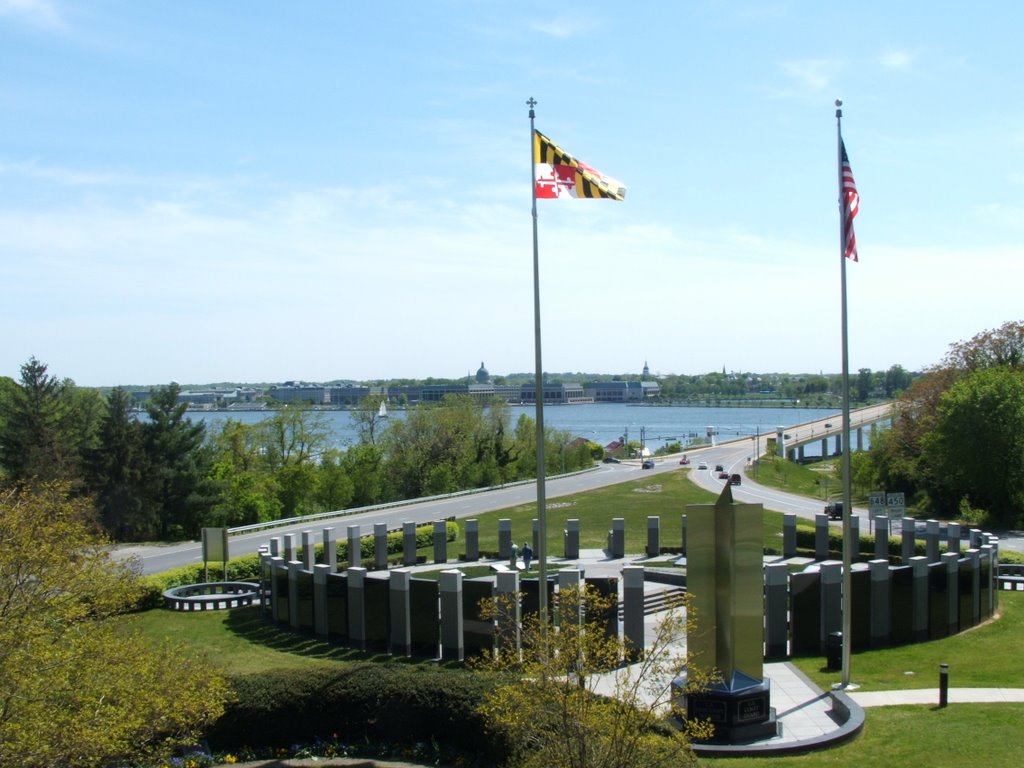
On a recent visit to Annapolis, Maryland I stumbled across the Maryland World War II Memorial. I posted pictures of the National WWII Memorial a while back. The memorial is located immediately across the Severn River from the U.S. Naval Academy.


The memorial has the names of Maryland residents killed in the armed forces during WWII.

Wednesday, May 10, 2006

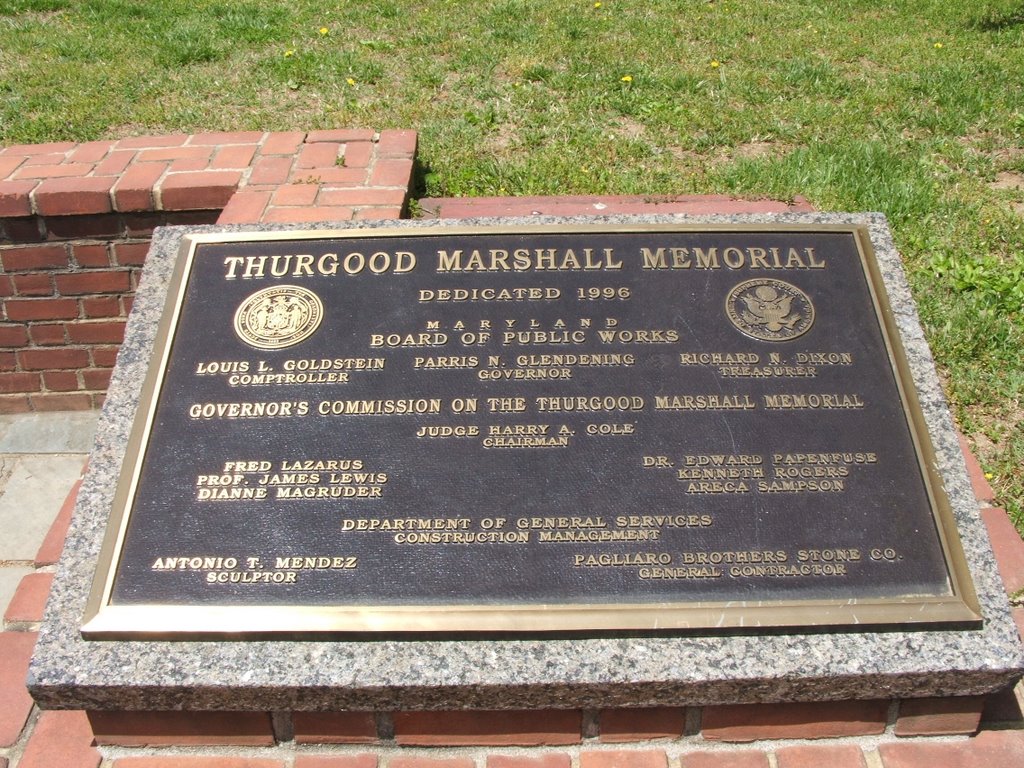
Thurgood Marshall Memorial

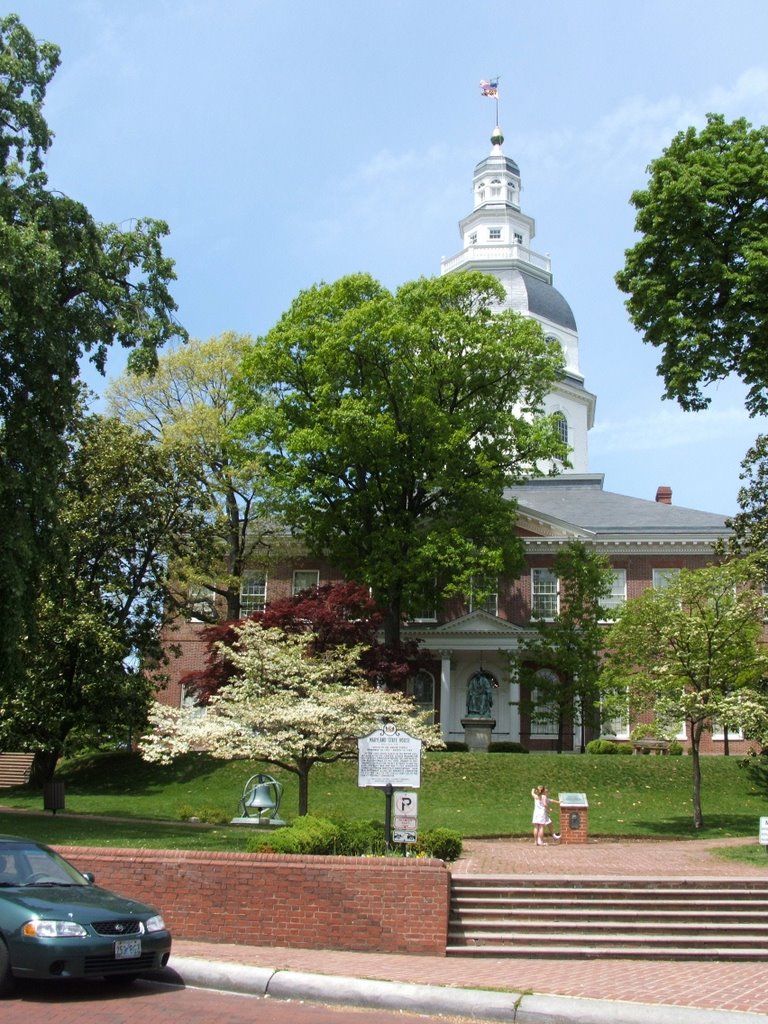
While strolling around historic Annapolis, Maryland (I got to combine a few hours of pleasure with a business trip to Baltimore), I stumbled across a memorial to Supreme Court Justice Thurgood Marshall. Its across the street from the Maryland State Capital as is shown on this photo below. All pictures taken in April 2006.

The memorial from the front.

A close-up of the memorial plaque.


Saturday, May 06, 2006

Remember the Maine!

The USS Maine was blown up in Havana harbor on February 15, 1898. The foremast of the USS Maine was recovered on October 6, 1910 and errected as a memorial on the campus of the US Naval Academy in Annapolis, Maryland on May 5, 1913.


Thursday, May 04, 2006

Annapolis was the United States Capital for About 9 Months

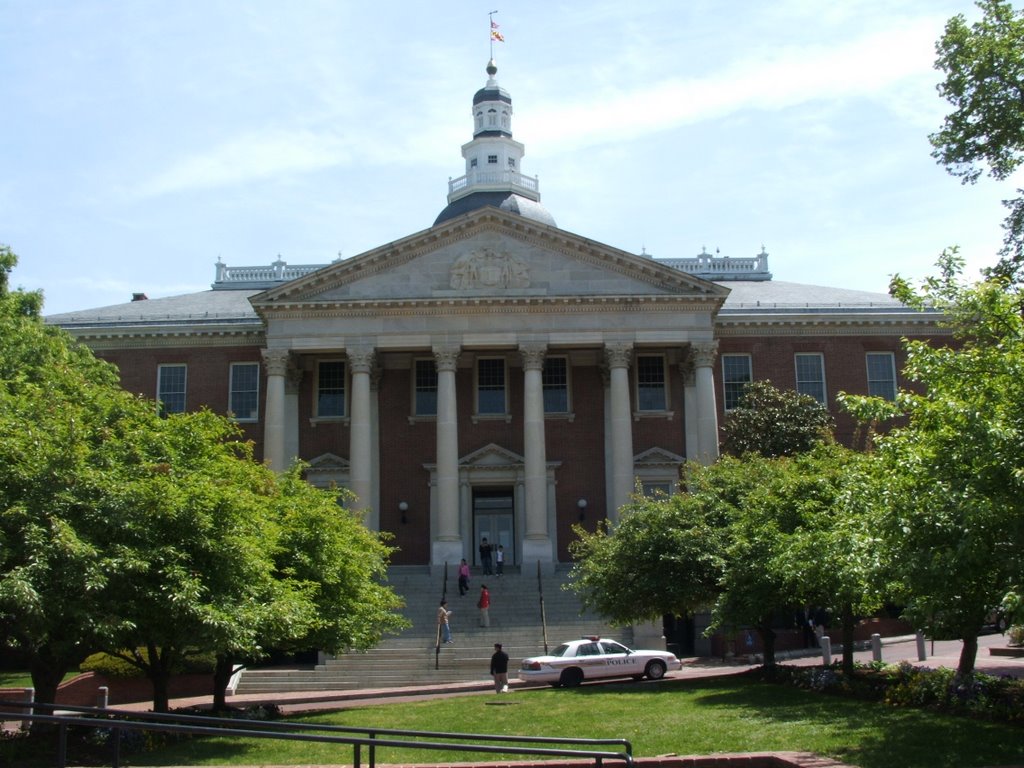
Below is a picture of the Maryland State Capital building, the oldest state capital still in use. It was also the US capital for about 9 months before Washington, DC existed. This picture taken in April 2006.


Here's a historical marker with more detail


A huge painting of George Washington resigning his commission as Commander in Chief of the Continental Army to Congress in Annapolis hangs in the rotunda of today's US Capital building. Click here for more details.

The other side of the Maryland State Capital.

Sunday, April 30, 2006

Washington, DC Surrounded by the Confederacy?

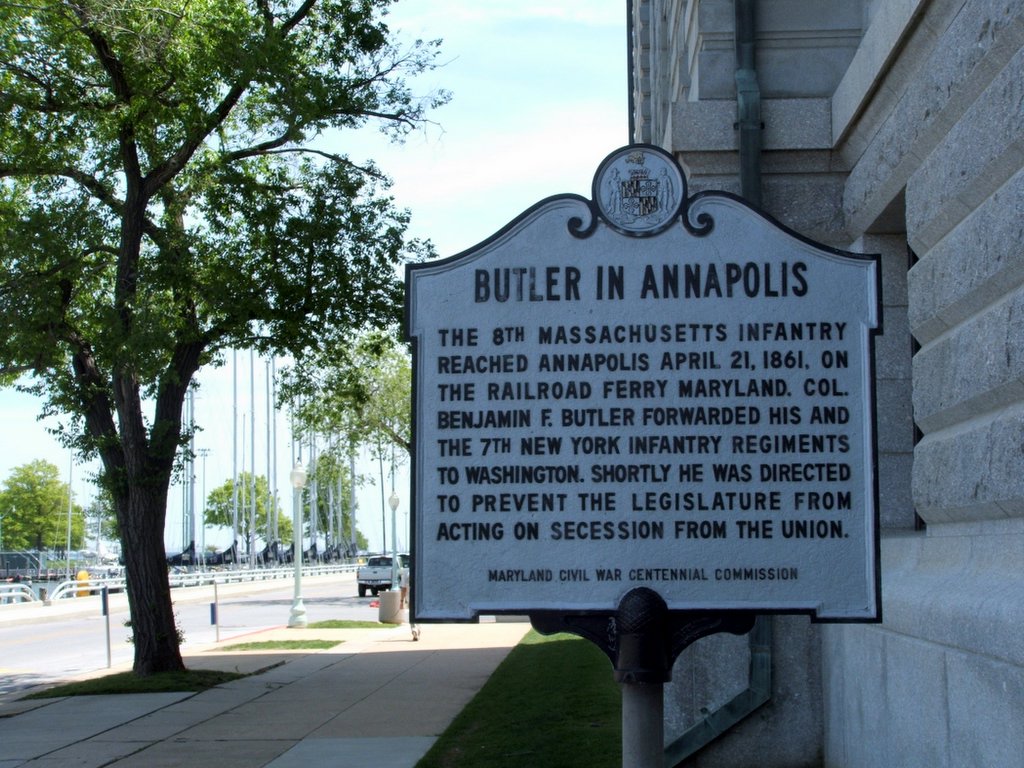
I find the historical marker below on the campus of the United States Naval Academy in Annapolis, Maryland really interesting. It isn't necessarily well known that owning slaves was legal in Maryland when the Civil War broke out in the United States. However, Maryland and a few other "slave states" did not secede from the United States of America (the Union) to join the Confederate States of America. (Missouri was another example of a slave state which did not secede.)

If you don't know your geography very well, you may not realize that Maryland is immediately west, north, and east of Washington, DC. Virginia which was part of the Confederacy was to the west, south, and east. Therefore, if Maryland had sided with the Confederacy in the Civil War, President Abraham Lincoln and the United States Capital in Washington, DC would have been surrounded by the Confederacy.

Based on the historical marker below, it appears that the Union did not want to allow this unpleasant possibility to occur. Union troops took over the Maryland capital of Annapolis and physically prevented the Maryland Sate Legislature from convening and even considering a motion to secede from the Union.

I'm not advocating this should have happened... I'm glad we no longer allow slavery. However, just imagine how United States history might have been different if Washington, DC had been surrounded by the Confederacy at the beginning of the Civil War.

 Posted by Picasa

Tuesday, March 07, 2006

Senator John McCain - Faith of My Fathers

As I’ve mentioned before I am an avid “reader” of audio books. My most recent book was Faith of my Fathers by US Senator John McCain and Mark Salter. I must say I learned a great deal about the men that shaped the life of one of my favorite politicians.

Senator McCain’s Grandfather
  • Annapolis graduate
  • A US Navy officer who rose to at least 3-star Admiral but I think he made it to, reporting directly to Admiral Halsy. He might have been a 4-star.
  • Involved in numerous naval battles in WWII as commander of squandron of fast carriers.
  • Was present at the Japanese surrender ceromony in Tokyo Bay.
  • Had one major incident of adversity. He was relieved of his command near the end of WWII not for failure with the enemy but for damage to ships and for men washed overboard and lost at sea during a typhoon.
  • Died just a few days after returning home after WWII.
Senator McCain’s Father
  • Annapolis graduate, graduating in the bottom 25%
  • Commanded submarines during WWII
  • Eventually rose to 4-star admiral.
  • Was appointed to the US Navy’s second highest position, Commander in Chief Pacific (CINCPAC) during the Vietnam War.
  • Henry Kissinger told future Senator McCain after the war that whenever he felt President Nixon was losing his resolve to fight the North Vietmanese, he would arrange for Senator McCain’s father to brief President Nixon on the war and miliary options.
  • Died like his father, shortly after fighting his nation’s war.
Senator McCain
  • Annapolis graduate, graduating near the bottom.
  • Naval aviator.
  • Volunteered for combat assignment off Vietnam.
  • Asked to be part of a particularly dangerous mission over Hanoi.
  • Shot down over Hanoi.
  • Injured in the shootdown, denied medical treatement for a long time until the Vietmanese realized his father was CINCPAC.
  • Could not move his arms or walk for months.
  • Beaten and tortured in prison.
  • Was once beaten so severly he signed a war crime “confession” and made an audio recording which was played over the loud speaker at the prison camp, humiliating him.
  • Offered early release from POW camp in Vietmanese attempt to embarase his father was a “big admiral” but he refused to leave before others who had been imprisoned longer.
  • When released from POW camp, he could barely walk without crutches due to untreated injuries. After some surgery and physical therapy, he eventually got flight status back but was eventually dischardged.
Other interesting stories include:
  • At the beginning of the war, the US was so afraid of China or the Soviet Union joining the conflict that Washington refused Navy recommendations to mine North Vietnamese harbors for fear of damaging Chinese and Soviet ships.
  • McCain flew over Soviet ships with surface to air missles being offloaded from the deck, but was under orders not to bomb the Soviet ships.
  • The US also resisted the idea of bombing Hanoi
  • How POW’s would communicate with each other via tapping on walls and talking thru drinking cups.
  • Stories of deep friendships formed between isolated men who might not see each other much, simply from being willing to risk the beatings to communicate with them.
  • How POW’s would celebrate date such as birthdays and anniversary of joining their military service as a group whenever possible.
  • How the POW’s once waged a hunger strike to get the privilege of weekly religious services.
  • How the POW morale improved greatly when they heard B-52 raids over Hanoi. They took this as a sign that the US was finally showing the resolve to fight hard enough to bring the war to a close and get them home. They cheered as their guards saught shelter from the raids. One one occasion, shrapnel sprayed his POW camp but they clapped and cheered anyway.
  • How two US officers in one of the POW camps capitulated to the enemy and helped the North Vietmanese identify prisoners who were communicating with each other, one time turning in McCain. McCain received a beating as a result.
  • Once McCain was bound tightly, beaten, and left tied up tighly for the night. A camp guard he had not had much interaction with came in and quietly loosened the ropes that bound him that evening. The same guard returned early in the morning and tightened the ropes again. A couple of days later, the guard came along side him and without speaking made a Christian cross in the dirt with his foot. Niether spoke. The man then erased the cross with his foot and walked away, never speaking to McCain.

I highly recommend this book as a story about adversity and how much adversity people can withstand. Its also worth it as a reminder about the sacrifice that some members of our Armed Forces have willingly made for our freedom.


Thursday, March 02, 2006

Eagle's Nest

This picture of me taken in the summer of 1989 at Hitler's Eagle's Nest retreat in the Bavarian Alps near Berchtesgaden, Germany and Saltzburg, Austria. It was actually pretty chilly up there. I think the tour guide said that a political hack had built the retreat at great expense to impress Hitler and gain his favor. Little did he know that Hitler was afraid of heights and only spent a very few nights there.

Posted by Picasa

Sunday, January 22, 2006

American Flag as a Symbol both of Freedom and Overwhelming Force

A quote from General George C. Marshal on the World War II Memorial in Washington, DC.

"We are determined that before the sun sets on this terrible struggle our flag will be recognized throughout the world as a symbol of freedom on the one hand and of overwhelming force on the other." Posted by Picasa

Saturday, January 14, 2006

A Last Vestige of the Cold War

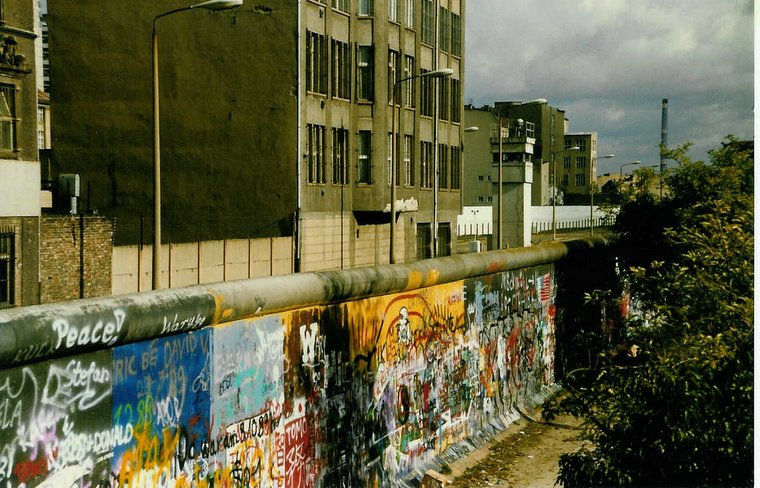
This shot of the Berlin Wall was shot on a visit there about two weeks before the wall "fell" from the West Berlin side.

Note the guard tower. Posted by Picasa

Thursday, December 29, 2005

Politics as Usual in Early American History

I have been continuing to listen to the 26-CD long, unabridged biography of John Adams when driving in my car. I am at about CD number 21 now and I must admit I have enjoyed it much more than I ever expected. There has been so much interesting detail and tidbits of American history I never knew.

In the early days, the man with the second most votes in the Electoral College was elected Vice President. John Adams served two terms as Vice President under George Washington. He would later find out that Alexander Hamilton worked diligently to get Electors to withhold votes from Adams. After Washington served two terms, Adams was elected the second President despite much effort on the part of Hamilton and Madison to get Thomas Jefferson elected. By this times, sharp party lines had developed and as a result, the Vice President Thomas Jefferson held many different views than President Adams and he frequently conspired with Alexander Hamilton to undermine John Adams’ policies

Philadelphia was the early capital and it often hit by Yellow Fever epidemics in the summer months. On several occasions, most high officials left the city to escape the disease. Much government business was done by mail, which traveled slowly in those days.

Relations turned sour with France after the French Revolution. We had stopped supporting an army and navy, and France used its sea power to exclude us from trade from the French West Indies. France was at war with England and would intercept US shipping with England as well. Most of the North, including John Adams reacted with horror to the mass executions during the French Revolution and distrusted the new French government. Thomas Jefferson, James Madison, Alexander Hamilton and much of the South had more distrust of England and looked at the French revolutionary cause as similar to our own and wanted to align ourselves with France. They blamed the problems with France on John Adams’ insulting the French years earlier when Adams served in Paris with Benjamin Franklin and later as one of the negotiators of the Treaty of Paris.

John Adams made the mistake of asking George Washington’s cabinet to stay on rather than choosing his own. (No precedent had yet been set as to cabinet level officials stepping down and the newly elected President picking his own cabinet.) In fact, most of his cabinet officials were really loyal to Alexander Hamilton.

Alexander Hamilton is presented in the biography as constantly trying to maneuver behind the scenes to control events. He was also found out to be in an adulterous relationship with another man’s wife.

Relations with France got worse when the new government refused to accept an American delegation sent by Adams to seek peace. As a result, Adams proposed to Congress to begin building an American Navy again and begin building an American Army just in case peace could not be negotiated. John Adams nominated George Washington, the former President, to come back to be the highest ranking general in the new army. Adams also nominated other influential men including Alexander Hamilton and his own son-in-law (who had rank of Colonel during the Revolution) also as generals. Washington would only accept his new commission if he could name his own generals under him. Alexander Hamilton was up to his usual behind-the-scenes maneuvers again, and Washington appointed Hamilton as second in command.

So... the plot continues to thicken. After going through high school and receiving a “rose colored glasses” view of history, it is interesting to see get this rather unvarnished version of events.


Wednesday, December 21, 2005

More on John Adams: Paris and the Netherlands

My on-going post about John Adams, from an audio book biography of the Revolutionary War era statesman that I’ve been listening too....

Adams was sent to join Ben Franklin in Paris to assist in negotiations for French recognition, military support, and trade. (There were concerns about Franklin’s age.)

After an American military victory at Saratoga, France did agree to help America against the British. However, the French Foreign Minister eventually came to dislike Adams’ manner and Adams’ insistence on British recognition of American Independence. (He secretly was only interested in separating the colonies from Britain to enhance trade with America. Also, he really wasn’t that keen on democracy as he supported the French monarchy. He also wanted to keep open the option of negotiating peace in the future with Britain that did not include Independence. He knew this is something Adams would never accept.

The French Foreign Minister thus began campaign to discredit Adams in the Continental Congress via France’s representative to Congress. He also spoke poorly of him to Ben Franklin, whom he liked better. Unknown to Adams for several months, Ben Franklin wrote a letter to Congress siding with the Foreign Minister.

Eventually, Congress did indeed make Franklin the sole representative and did not even mention Adams in the letter sent to Paris. Unsure then of his status in Paris and feeling treated shabbily by the Continental Congress, John Adams returned to his family in Massachusetts.Not too much later, however, Congress gave him yet another appointment to return to Paris. This time he was sent to Paris with the sole authority to represent the Congress in any future peace negotiations with the British. I guess because of how long it took to travel to Europe in the 1700’s, the feeling was that they should send someone well in advance in anticipation that American success on the battlefield would bring the British to the negotiating table... and Congress wanted someone to be in Europe already to lead these negotiations so as to eliminate any travel delays.This time, Adams took two sons with him. It was John Quincy Adams’ second trip to Paris. His younger brother was only 9 at the time he embarked to sail across the Atlantic with his statesman father. Again, I found myself amazed at the rare opportunity the boys had to observe history being made first hand.While waiting for the British to get interested in peace talks, he began a propaganda campaign of sorts. He wrote letters to be submitted to British newspapers via American agents that would be supportive of the American cause.


The French Foreign Minister again tried to get Adams removed as the sole negotiator of peace with the British. Adams was judged as too insistent on recognition of American independence.... a point the French wanted to have the option to compromise on if it suited their interests.As a result, the French representative to the Continental Congress again disparaged Adams in Philadelphia. Instead of removing Adams, however, Congress voted to change the peace negotiations from a single person (Adams) to a team of five members of Congress from different geographies. Adams would stay on representing Massachusetts, Ben Franklin would represent Pennsylvania, Thomas Jefferson would represent Virginia, and there would be two others I can’t remember.Thomas Jefferson would not show up in Paris for some time for personal reasons related to the health of his wife.

While waiting on the British to seek peace, Adams was dispatched by Congress to the Netherlands to try to get official recognition of an independent United States and secure loans from banks there.With Adams in the Netherlands (and Jefferson not showing up), for all practical purposes the French Foreign Minister had arranged things temporarily so that he only had to deal with Franklin which suited him fine.

After word of the British defeat at Yorktown reached the Netherlands, they did agree to recognize the United States. Adams supervised the purchase of the first United States embassy bought in any foreign country and became the first Ambassador to the Netherlands.

Tuesday, December 20, 2005

The Integrity of John Adams

Continuing my listening to the audio book on John Adams....

The picture painted by the biography of John Adams is one of a man of great integrity and honesty. Some examples,
  • His concern for how the commissioners to the French in Paris spent the public money. (Ben Franklin seemed to have no records of what he spent and avoided accountability)
  • He kept a detailed journal in which he regularly criticized his own behavior and pledged efforts at self improvement.
  • By all accounts he was quite faithful to his wife despite being separated by the Atlantic Ocean for over 3 years.
  • During negotiations of the Treaty of Paris, the British wanted Americans to have to pay any debts they owed British merchants that were incurred before the war broke out. The other Americans wanted to avoid any treaty language on this. Adams felt, however, that the only honorable thing was to pay these as legitimate debts unrelated to the war.

Monday, December 19, 2005

Benjamin Franklin vs. John Adams

Continuing my listening to the audio book on John Adams...

It turns out that John Adams and Ben Franklin didn’t always see eye to eye in Paris while they were trying to secure French support for the Revolution.

* As John Adams’ French improved he came to realize that Ben Franklin, as popular as he was with the French public, really didn’t speak or understand French very well.
* A good steward of the public money, he thought Ben Franklin spent public funds too lavishly

Once the French entered into the American Revolution, he French Foreign Minister it seems was willing to compromise on American independence should it become necessary to negotiate with the British. Knowing that John Adams would never stand for that, he began an effort to discredit John Adams. He instructed the French representative to the Continental Congress in Philadelphia to try to get John Adams recalled. He complained to Ben Franklin.

At one point, Ben Franklin sent a letter back the Continental Congress implying that John Adams had offended the French. This little detail would not become known to John Adams for several months as it took that long for the letter to cross the Atlantic and for the news to come back across the Atlantic from his wife and friends. This eventually lead to new instructions from the Congress which put Franklin solely in charge of negotiations with the French and made no mention of Adams.

Adams took this as an opportunity to return to Massachusets and be with his wife and children.

Korean War Memorial


I shot this photo at the Korean War Memorial in Washington, DC in December of 2004. The statue closest seems to have a "Are you coming with us?" expression on his face.
 Posted by Picasa

Sunday, December 18, 2005

My Admiration for John Adams Grows

Continuing my listening to the audio book on John Adams....

A few interesting facts about John Adams that I never knew... and which only add to my admiration and respect for the man.

  • During the Continental Congress, he served as the chairman of the “war” committee and as such had to get Congress to authorize commissions for officers, payroll, building of ships for a navy, etc.
  • He was sent to Paris to join Benjamin Franklin in Paris to help get France to provide military support for the Revolution.

Something I didn’t know:
  • To go to France, he had to cross the North Atlantic in the dead of winter, which was dangerous enough
  • He risked the very real possibility of capture should the ship be captured by the British
  • He took his son, John Quincy Adams, with him though he was only age 10 or 11. My reaction was “Wow! What an opportunity for such a youngster. How many boys of that era got to be part of history like that?”
My admiration of his wife Abigail increased as well as I heard how she encouraged John Quincy to accompany his father and talked about what an opportunity this was for him. It was as if they were grooming him for the service of his country even at that young age.

Saturday, December 17, 2005

John Adams

My most recent audio book is John Adams by David McCullough. I normally don’t choose biographies but I find myself truly enjoying it. I may have to reconsider my audio book choices. This audio book is the unabridged version and takes up 26 CDs so I am nowhere near finished yet.


Several ideas struck me as significant in the beginning of the biography:

  • I am amazed at how well read John Adams was. By today’s standards he would surely be considered an intellectual for he would read Roman books in Latin, Greek books in Greek, and English poets. As a lawyer, he had standing orders with London booksellers to ship a copy of any new title on law or government. I found myself wondering if we can produce minds like the founding fathers anymore when TV, DVDs, computer games, the Internet, etc. compete for the attention of our brain cells.
  • Similarly, the founding fathers quoted had incredible vocabularies. Shame on me for my own vocabulary being so meager in comparison.
  • I have been struck by the personal sacrifice of the founding fathers of the US. When John Adams accepted a position in the Continental Congress, it took a couple of weeks to make the trek from the then Massachusetts colony to Philadelphia by horseback. He was gone from his wife and children for months with the only communication being by letters which took just as long to travel back and forth.
  • I find myself admiring John Adams’ wife Abigail as well. The letters from her to her husband which have been quoted reveal real love and devotion, her own keen intellect, and her support for the patriotic cause of her husband.